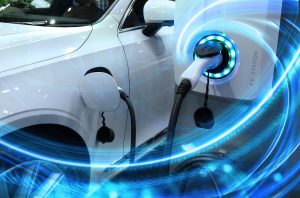
For the past few years, the main marketing point for Electric Vehicles (EVs) has been focusing on “zero maintenance.” No oil change, no spark plugs to gap and no timing belts to snap. The EV has been marketed as a pretty much set-it-and-forget-it machine. However, owners have started discovering a “hidden” line item in their budget that is higher than their old internal combustion engine (ICE) vehicles. Shifting to EV hasn’t eliminated maintenance. It has moved the financial burden from the engine bay to the wheels.
When looking for the price of tyre alignment and balancing, it is clear that these are no longer elective or luxury services. They are one of the most important operations for protecting your EV’s bottom line.
Heavy Batteries
The answer to the rising maintenance costs begins with a simple law of physics: mass. Batteries are heavy, and a typical mid-sized EV often weighs around 400 kilograms more than a similarly sized ICE vehicle due to the high-density lithium-ion packs. This puts immense pressure on the suspension system and the tyres’ contact patch. When you drive a lightweight car, a slight misalignment could take months to show uneven wear. However, in a heavy EV, that same misalignment can accelerate tread loss significantly.
This basically makes the price of tyre alignment and balancing a proactive insurance policy. Paying for an alignment is still cheaper than replacing a set of premium EV tyres earlier because the heavy chassis “scrubbed” the rubber off the inner shoulders.
Instant Torque
One of the most popular and celebrated features of EVs is instant torque. Compared to an ICE vehicle that needs to “rev up,” an EV delivers 100% of its turning force the moment you touch the pedal. This is definitely a thrilling driving experience to some people; however, it is brutal on tyre longevity.
If your wheels are not aligned and balanced, that instant torque is distributed unevenly across the tread, leading to “micro-slippage,” tiny invisible skids where the tyre fights for grip against the pavement. This can remove millimetres of rubber off a tyre in a single season of spirited driving.
Since many EVs use aggressive regenerative braking to slow down, the tyres are under constant pressure during both acceleration and deceleration. Without precise balancing, this dynamic creates vibrations that can eventually damage the tyres.
Efficiency
When it comes to EVs, efficiency is measured in Watt-hours per kilometre. When car wheels are not aligned, the car basically suffers from increased rolling resistance. If your wheels are toed in or toed out, the tyres are trying to pull the car in two different directions at once.
For an EV, this translates directly into a loss of battery range. Poor alignment can reduce vehicle efficiency by up to 10%, which means that a misaligned car is literally leaking money at every charging station. Regular alignment makes sure that the energy you pay for is used to move the car forward, not to fight against the friction of its own wheels.
Specialised Tech
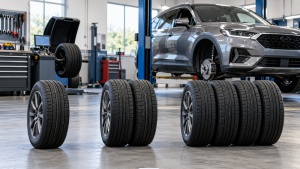
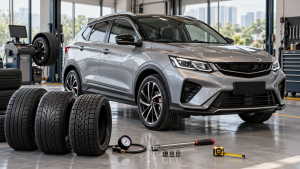
Many owners may ask themselves why the price of tyre alignment and balancing for an EV can sometimes be higher compared to a standard car. Modern EVs are rolling computers equipped with Advanced Driver Assistance Systems (ADAS). When a technician performs an alignment on EVs such as Tesla or Audi e-tron, they often have to recalibrate the steering angle sensors and cameras that power Lane Keep Assist and other autonomous features.
If you were to change the mechanical alignment without resetting the digital sensors, it can result in the EV’s safety systems “seeing” the road incorrectly. This means that wheel maintenance is now a high-level digital calibration that requires specialised 3D laser equipment and trained technicians.
Maintenance Schedule
While standard cars may require an alignment check every two years, EVs are slightly different. Drivers should have check intervals every 10,000-15,000 kilometres or at the first sign of “drifting” during regenerative braking.
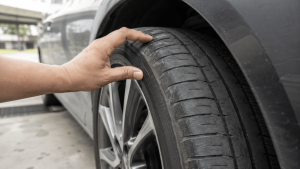
Since EVs put unique loads on drive wheels (often the rear in many base models), rotating tyres could help with equalising wear. Since EVs have no engine, drivers should listen for increased road hum, which is often the first sign of an out-of-balance tyre or a cupping wear pattern.
Shifting to the EV era means we are moving away from “fluid-based” maintenance to a “chassis-based” one. By understanding that the price of tyre alignment and balancing is a vital operational cost, EV owners can ensure that their vehicle remains both economic and efficient.